Best Domain Registrar for a US LLC (and What to Avoid)
Pick the best domain registrar for your US LLC: honest renewal pricing, free privacy, and clean ownership. Plus the common mistakes non-residents make.
For most new US LLCs, the best domain registrar is Cloudflare Registrar, Porkbun, or Namecheap. All three have fair renewal pricing and free WHOIS privacy, and they don’t push hosting bundles on you. Register the domain in your LLC’s name, under an account you control, and keep it separate from your web host.
Bottom line
- Lowest long-term cost: Cloudflare Registrar sells domains at cost, but you have to use Cloudflare for DNS.
- Best all-rounder: Porkbun or Namecheap. Both are simple, include free privacy, and let you use any DNS or host.
- Avoid: registrars with cheap first-year promos and steep renewals, paid “privacy” add-ons, and letting a freelancer register the domain in their own account.
What is a domain registrar?
A domain registrar is a company accredited to sell and manage domain names, like yourbrand.com, on your behalf. You rent the domain one year at a time. The registrar holds the record of who the legal registrant is.
The registrar and the web host are two different services. The registrar controls who owns the name. The host stores and serves your website. Keeping them with separate companies is the single most useful decision you can make here, and we explain why below.
Best domain registrars for a US LLC compared
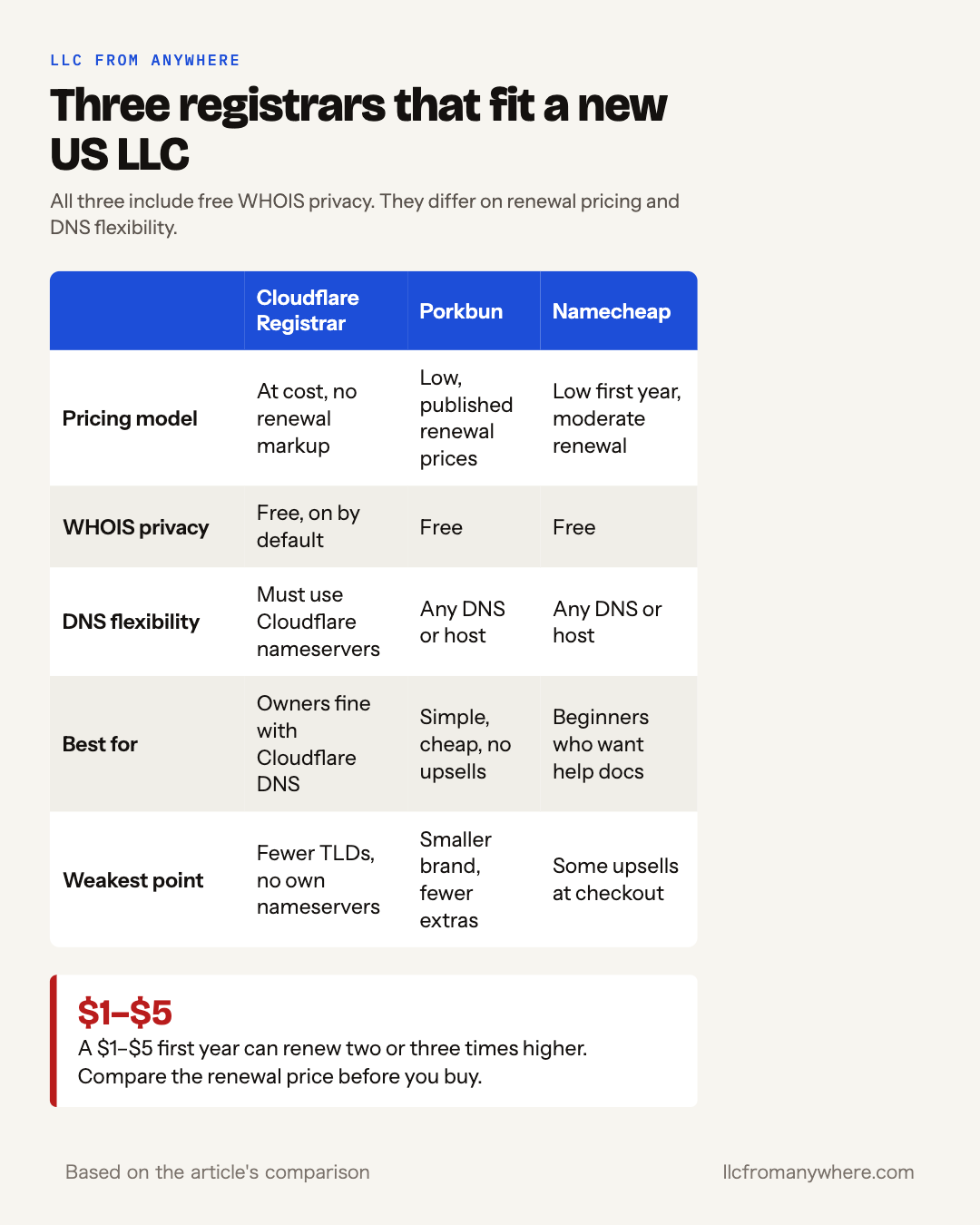
The best domain registrar for a US LLC is one with transparent renewal prices, free privacy, two-factor login, and no lock-in to its own hosting. The three below meet that bar. GoDaddy is included because many owners start there by default.
| Cloudflare Registrar | Porkbun | Namecheap | GoDaddy | |
|---|---|---|---|---|
| Pricing model | At cost, no markup on renewals | Low, published renewal prices | Low first year, moderate renewals | Promo first year, higher renewals |
| WHOIS privacy | Free, on by default | Free | Free | Included on many plans, check at checkout |
| Best for | Owners comfortable with Cloudflare DNS | Simple, cheap, no upsells | Beginners who want lots of help docs | Owners who want everything in one dashboard |
| DNS flexibility | Must use Cloudflare nameservers | Any DNS or host | Any DNS or host | Any DNS or host |
| Standout feature | No renewal markup | Clean checkout, free SSL and email forwarding | Large TLD selection, mature dashboard | Phone support and brand recognition |
| Weakest point | Fewer TLDs; can’t use your own nameservers | Smaller brand, fewer extras | Some upsells at checkout | Renewal prices and add-on upsells |
Prices change often. Check each registrar’s current pricing page for the renewal price, not just the first-year price, before you buy.
Which registrar costs the least over time?
Cloudflare Registrar usually has the lowest multi-year cost, because Cloudflare passes through the registry’s wholesale price plus the ICANN fee with no markup. Porkbun is close behind for most common extensions.
A standard .com costs roughly $10–$12 a year at cost. The exact number depends on what Verisign, the .com registry operator, charges that year. Retail registrars add their margin on top. The usual trap is a $1–$5 first year followed by a renewal two or three times higher.
Compare the renewal price before you buy. A domain stays with your business for years, so year two and beyond matter much more than the promo.
Does your LLC need WHOIS privacy?
Yes. Unless you’re registering a .us domain, turn privacy on. It keeps your name, address, phone, and email out of the public domain lookup, which cuts down on spam and scam “domain renewal” letters.
WHOIS privacy is a service that replaces your contact details in the public domain record with the registrar’s proxy details. Cloudflare, Porkbun, and Namecheap include it free. Don’t pay extra for it anywhere.
The .us exception: the .us registry requires a US nexus and does not allow privacy or proxy services. A US LLC meets the nexus requirement, so you can register a .us, but your registrant details will be public. For a non-resident owner, that’s one more reason to stick with .com.
Whose name should the domain be registered in?
Register the domain with your LLC as the registrant organization, under a registrar account that you personally control. That makes the domain a business asset and keeps it clean if you sell the company, bring in a partner, or prove ownership to a payment processor or bank.
Use these details in the registrant contact:
- Organization: your exact LLC name, as filed with the state.
- Email: an inbox you’ll always have access to. Don’t use one hosted on the same domain you’re registering. If that domain lapses, you lose the email you’d need to recover it.
- Address: the business address you use on your other records. If you’re unsure which address to use, see our guide to getting a US address for your LLC.
ICANN rules require accurate registrant information. Registrars also verify your email address after registration, and the domain can be suspended if you don’t click the verification link in time. Watch your inbox right after you buy.
How to pay for a domain from outside the US
Most major registrars accept international credit and debit cards, and several also take PayPal. Before you commit, check the registrar’s payment page for your card type and country.
Once your LLC has a US business bank account, move domain billing onto the business card so the expense is in the company’s books. If you haven’t opened one yet, our guide to a US business bank account for non-residents covers the options.
Card expiry is the most common reason domains lapse. When you get a new card, update it at the registrar the same day.
What to avoid when registering your LLC’s domain
Most domain problems come from five avoidable mistakes. Each one either costs you money every year or makes your own domain hard to control.
1. Letting someone else register it. A web designer or agency that registers the domain in their own account technically controls your brand. Register it yourself and give them access to DNS only if they need it.
2. Getting your domain free with hosting. “Free domain for the first year” deals tie your domain to the host. Moving later means a transfer, a waiting period, and sometimes a renewal fee higher than the market rate. Keep the registrar and the host separate.
3. Paying for add-ons you don’t need. Paid privacy, “domain ownership protection,” bundled email trials, and “SEO boost” packages are mostly upsells. Free privacy, a registrar lock, and two-factor login cover what matters.
4. Skipping auto-renew. An expired domain can go to auction and get bought by someone else. Turn on auto-renew, keep a valid card on file, and consider registering for several years at a time.
5. Leaving the account unsecured. Turn on two-factor authentication and the registrar lock (also called transfer lock). A hijacked registrar account can take down your website and email together.
One timing rule to know: a newly registered or transferred domain generally can’t be transferred to another registrar for 60 days. Pick a registrar you’re happy with before you buy.
Connecting your domain to a website host
Your registrar holds the name. Your host runs the site. You connect them by pointing your domain’s DNS records (or nameservers) at the host, which usually takes a few minutes in each dashboard.
For a business website on WordPress, we like managed hosting that handles speed, security, backups, and updates, so you’re not maintaining a server from another time zone. Kinsta is premium managed WordPress hosting. It’s a good fit if your site is your main sales channel and you want strong performance and support. Kinsta doesn’t sell domains, which suits the setup we recommend: buy the domain at one of the registrars above, then point it to your Kinsta site.
Kinsta plans start around $35/month, so check the current pricing page. For a side-by-side of hosts at different budgets, read our guide to the best web hosting for your US LLC website.
Who should pick Cloudflare Registrar
Pick Cloudflare Registrar if you want the lowest renewal cost for years and don’t mind running DNS through Cloudflare. It suits owners with a few domains who care about long-term cost and are comfortable in a technical dashboard.
Skip it if you need a TLD Cloudflare doesn’t support, or if your host or setup requires its own nameservers.
Who should pick Porkbun or Namecheap
Pick Porkbun if you want low published prices, free privacy, and a checkout without upsells. Pick Namecheap if you’d rather have a long-established registrar with extensive help articles and a wide range of extensions.
Both let you use any host or DNS provider. That makes either one a safe default for a first LLC website.
Who should avoid bundled or promo-heavy registrars
If you’re comparing prices only on the first year, slow down. Registrars that lead with promo pricing often make the money back on renewals and add-ons. Paying a few dollars more upfront at an honest-pricing registrar usually costs less over three to five years.
This is general information about domains and business setup. For questions about how your LLC should hold and expense business assets, confirm with a CPA or attorney.
FAQ
Do I need an LLC before I register a domain?
No. You can register a domain before forming your LLC, and it’s smart to secure the name early. Once the LLC exists, update the registrant organization to the LLC’s exact legal name.
Can a non-US resident register a .com domain?
Yes. .com has no residency requirement, and anyone can register one through an accredited registrar. .us is different: it requires a US nexus, which a US LLC satisfies, and it does not allow WHOIS privacy.
Should I buy my domain from my web host?
Generally, no. Keeping the domain at a separate registrar makes switching hosts simple and protects you if a hosting account is suspended or closed. Point the domain to the host through DNS instead.
How many years should I register a domain for?
One year with auto-renew is fine if your card is reliable. Registering for several years cuts the risk of an accidental lapse, but compare the total multi-year price with the renewal rate first.
Get your domain and site set up the right way
Register your domain at Cloudflare Registrar, Porkbun, or Namecheap in your LLC’s name, with free privacy, two-factor login, and auto-renew turned on. Then point it to a host built for business sites. If you want managed WordPress hosting that handles speed and security for you, start with Kinsta. To plan the rest of your setup, see our guide to forming a US LLC as a non-resident.
Tools mentioned in this article
Keep reading
Bizee (Incfile) Review: Is It Legit for Non-US Founders?
An honest Bizee (formerly Incfile) review for non-US residents: what the free formation plan really covers, hidden costs, and when to pick something else.
Northwest Registered Agent Review: Honest Take for Non-Residents
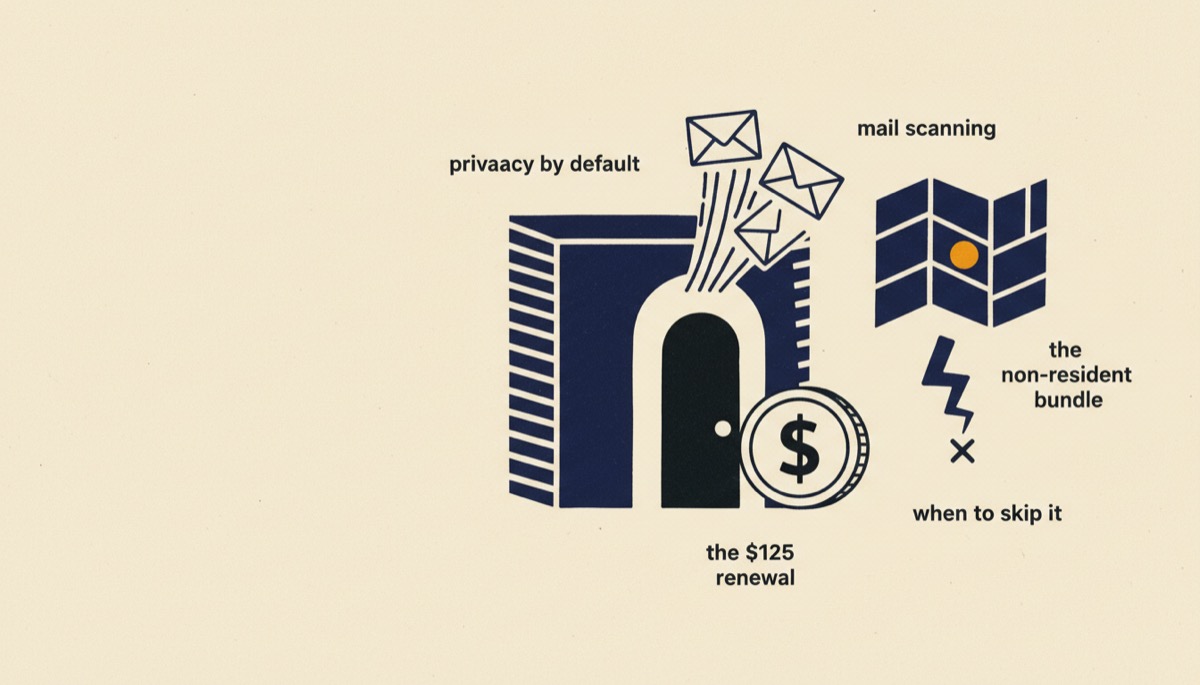
An honest Northwest Registered Agent review: privacy by default, mail scanning, the $125 renewal, the non-resident bundle, and when to skip it.
Best Web Hosting for Your US LLC Website
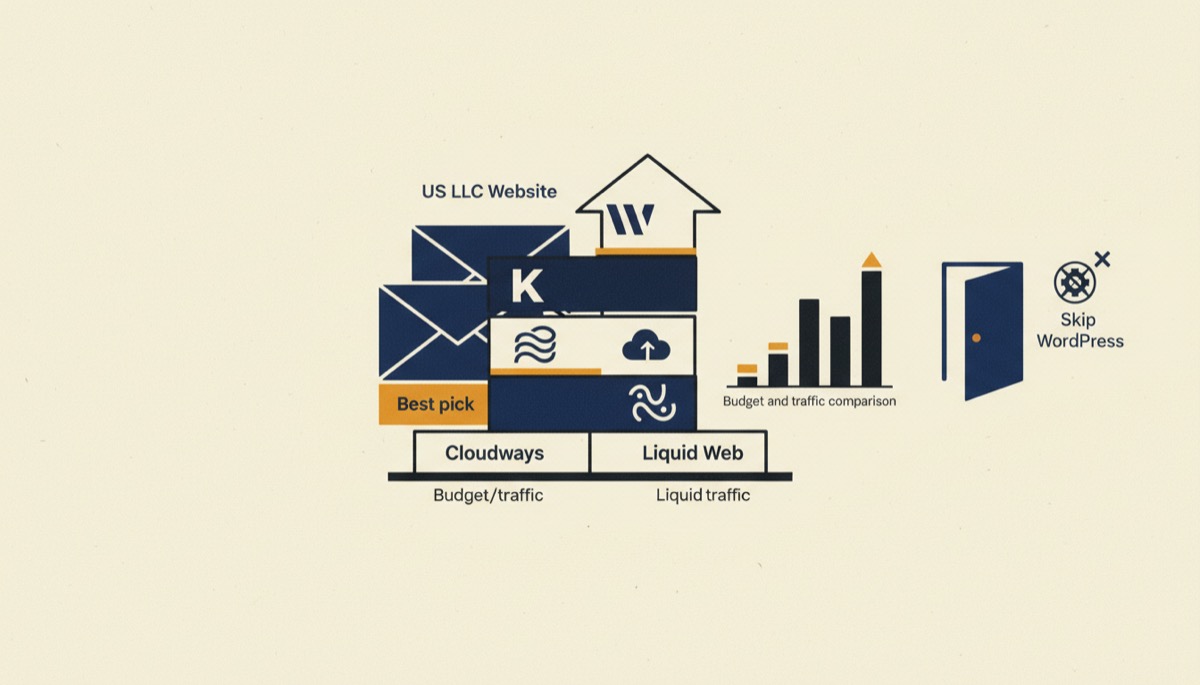
Managed hosting picks for a new US LLC website by budget and traffic: WP Engine, Kinsta, Cloudways and Liquid Web compared, plus when to skip WordPress.