Delaware vs Wyoming LLC for Non-Residents: Which State Wins?
Delaware vs Wyoming LLC for non-residents: compare filing fees, annual costs, privacy, and taxes to pick the right state for your US business.
For most non-residents, Wyoming is the better choice in the Delaware vs Wyoming LLC decision. It costs less to keep alive each year, has simple annual filing, and gives you the same federal tax treatment as Delaware. Delaware makes sense mainly if specific investors, partners, or legal advisors ask you to use it.
Bottom line
- Pick Wyoming if you run an online business, freelance, or sell digital or physical products and want the lowest ongoing cost.
- Pick Delaware if an investor, partner, or attorney specifically requires a Delaware entity, or you value Delaware’s business court and case law.
- Either way, your federal filings (including Form 5472 for foreign-owned single-member LLCs) are the same. The state does not change your IRS obligations.
Delaware vs Wyoming LLC: Side-by-Side Comparison
The biggest difference between a Delaware and a Wyoming LLC is the yearly cost of keeping the company in good standing. Formation costs are close, but Delaware’s annual tax is five times Wyoming’s minimum annual fee.
| Factor | Wyoming LLC | Delaware LLC |
|---|---|---|
| State filing fee | $100 (Wyoming Secretary of State) | $110 (Delaware Division of Corporations) |
| Annual state cost | Annual report license tax, $60 minimum | $300 flat annual LLC tax |
| Annual deadline | First day of your formation anniversary month | June 1 each year |
| Member names in public filing | Not required | Not required |
| Best for | Online businesses, freelancers, e-commerce, solo founders | Founders working with US investors or attorneys who require Delaware |
| Standout feature | Low upkeep and simple annual report | Court of Chancery and deep business case law |
| Weakest point | Less name recognition with some US lawyers and investors | Higher fixed yearly cost that does not depend on revenue |
Fees are set by each state and can change, so confirm the current amounts on the Wyoming Secretary of State and Delaware Division of Corporations websites before you file.
Which State Costs Less Over Time?
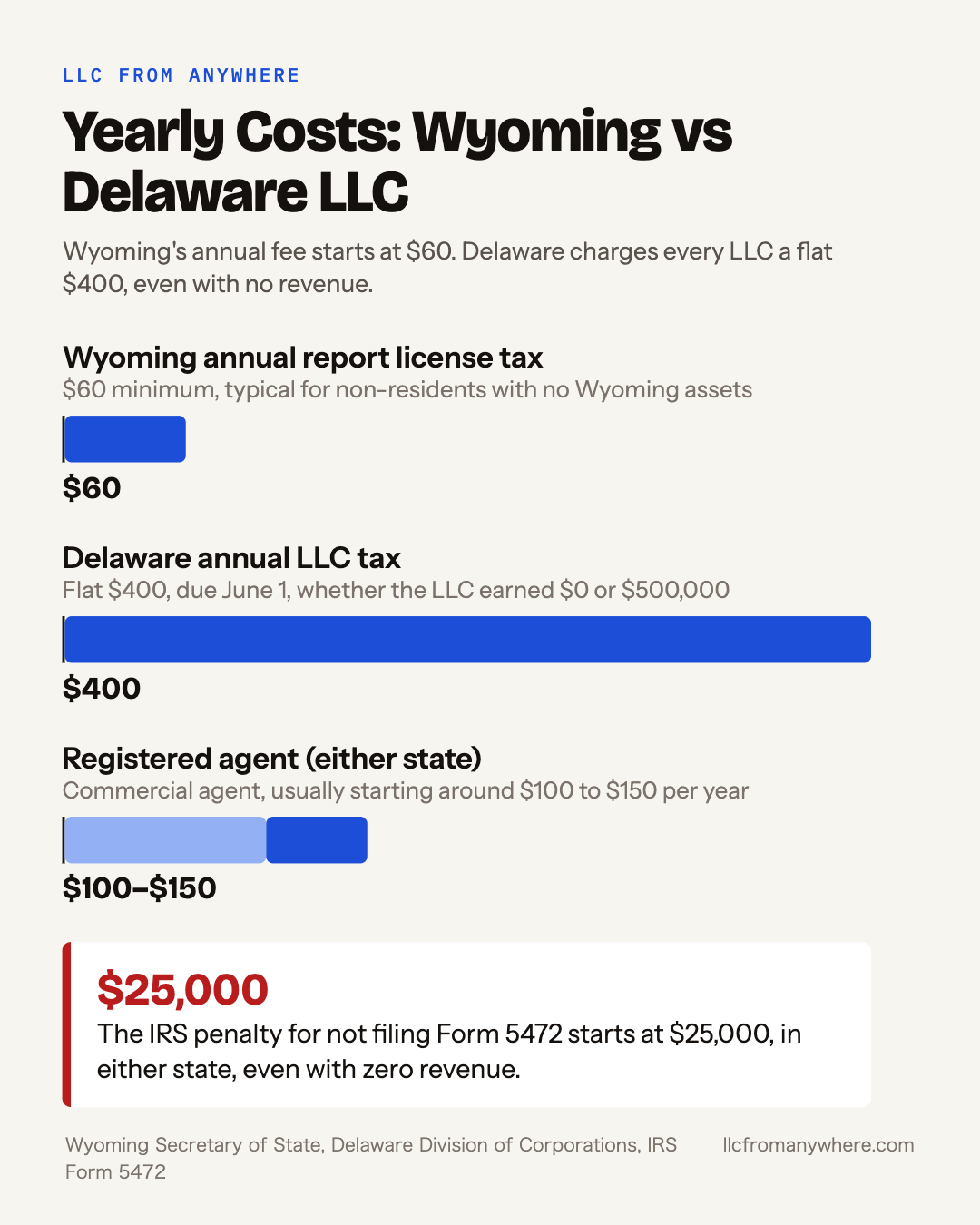
Wyoming costs less over time for almost every small foreign-owned LLC. The gap comes from annual fees, not formation fees.
The Wyoming Secretary of State charges an annual report license tax of $60 or two-tenths of one mill on assets located and employed in Wyoming, whichever is greater. For a non-resident with no Wyoming assets, that typically means the $60 minimum.
Delaware charges every LLC a flat $400 annual tax, due June 1, according to the Delaware Division of Corporations. It applies whether your LLC earned $0 or $500,000. Missing it triggers a late penalty plus monthly interest, and an LLC that stays unpaid can lose good standing.
Both states also require a registered agent. A registered agent is a person or company with a physical address in the state who accepts legal and government mail for your LLC. As a non-resident, you will pay a commercial agent, usually starting around $100 to $150 per year, in either state.
Add it up and a Wyoming LLC usually runs a few hundred dollars less per year than a Delaware LLC. Over five years, that adds up to real money for a small business. For a fuller cost breakdown, see our guide to the best state to form an LLC for non-residents.
Does the State Change Your US Taxes?
No. Your federal taxes as a foreign-owned LLC are the same in Delaware and Wyoming. A single-member LLC owned by a non-resident is a disregarded entity for US income tax purposes unless it elects otherwise, and the state you choose does not change that.
The federal filing that matters most is Form 5472 with a pro forma Form 1120. Foreign-owned single-member LLCs must file this every year to report transactions with their owner, even with zero revenue. The IRS penalty for failing to file starts at $25,000, so it deserves a spot on your calendar. Our walkthrough of Form 5472 for foreign-owned LLCs covers what to report.
At the state level, Wyoming has no state corporate or personal income tax. Delaware does have a state income tax, but a non-resident owner whose LLC earns no income from Delaware sources generally does not owe it. In practice, neither state taxes the typical online business run from abroad. Your home country’s tax rules usually matter more than either state’s.
You can also get an EIN without a Social Security number in either state. The IRS issues EINs to foreign owners through Form SS-4 by fax or mail, and many formation services handle that step for you.
Which State Offers Better Privacy?
Wyoming and Delaware both offer strong privacy in public filings. Neither state requires you to list members or managers on the formation document, so your name does not appear in the public business record by default.
The real privacy lever is your registered agent. If the agent’s address appears on your public filings instead of yours, people looking up your company see the agent, not you. Some services go further and let you use their address as your business address on state forms.
Wyoming also keeps its annual report simple, which means fewer documents with your details passing through the system each year. Delaware’s annual tax filing is similarly light for LLCs.
Federal rules are a separate matter. Beneficial ownership reporting requirements from FinCEN have changed several times, and foreign-owned companies may be treated differently than US-owned ones. Check FinCEN’s current guidance or ask your formation service whether your LLC must file.
If privacy is a top priority, Northwest Registered Agent is known for using its own address on filings and not selling client data.
Does Delaware’s Reputation Matter for a Small LLC?
For most solo founders and small online businesses, Delaware’s reputation adds little practical value. Its main advantages, the Court of Chancery and a large body of business case law, matter most in disputes between investors, partners, or shareholders.
The Delaware Court of Chancery is a business court that hears company disputes without a jury, and judges there have decades of rulings to draw on. That predictability is why large companies and venture-backed startups often choose Delaware.
There is a catch for founders thinking about outside investors. Venture capital funds usually want a Delaware C corporation, not an LLC. If you plan to raise venture money, forming a Delaware LLC now may not save you a conversion later. Talk to an attorney before choosing either state for that reason.
If none of those situations apply to you, Delaware’s name recognition does not help you open a bank account, get a payment processor approved, or sell more products. Banks and processors care about your EIN, your documents, and your business activity, not which state you filed in.
How Hard Is It to Run Each LLC From Abroad?
Both states are easy to manage from abroad, because neither requires you to visit or live in the state. You file online, use a registered agent for mail, and handle annual filings through the state website or your formation service.
The main difference is the calendar. Wyoming’s annual report is due on the first day of the month your LLC was formed, so every Wyoming LLC has its own deadline. Delaware’s $400 tax is due on June 1 for every LLC, which is easy to remember.
Neither state requires an operating agreement to be filed publicly, but you should still have one. Banks often ask for it, and it documents that you, a non-resident, own and control the LLC.
One more rule applies in both states. If your LLC has a physical office, staff, or inventory in another US state, you may need to register as a foreign LLC there too. Most non-residents running remote businesses do not trigger this, but warehousing goods in a US state can.
Who Should Pick Wyoming
Wyoming fits most non-residents who want a simple, low-cost US company. Choose it if:
- You run an e-commerce store, SaaS product, agency, or freelance business from outside the US.
- You want the lowest predictable annual cost.
- You do not plan to raise venture capital through this entity.
- You want strong default privacy without paying for extras.
Bizee is a low-cost way to file a Wyoming LLC if you want to keep upfront spending small. If you would rather pay a bit more for privacy-focused registered agent service, Northwest Registered Agent handles Wyoming filings as well.
Who Should Pick Delaware
Delaware fits a narrower group of non-residents. Choose it if:
- An investor, business partner, or lender specifically asks for a Delaware entity.
- Your attorney recommends Delaware for a multi-member LLC with a complex operating agreement.
- You expect disputes among members to be likely enough that Delaware’s courts are worth paying for.
- The $300 annual tax is a small cost relative to your revenue.
If Delaware is the right fit, both Northwest Registered Agent and Bizee can form a Delaware LLC and serve as your registered agent there.
FAQ
Is a Wyoming LLC cheaper than a Delaware LLC?
Yes, for most non-residents. Wyoming’s annual report license tax starts at $60, while Delaware charges every LLC a flat $400 a year. Formation fees are similar, so the savings come from annual upkeep.
Can a non-resident form a Delaware or Wyoming LLC without visiting the US?
Yes. Both states let you form an LLC online with no US residency or visit required. You need a registered agent in the state, and you can get an EIN without an SSN through Form SS-4 or a formation service.
Do I pay state income tax in Wyoming or Delaware as a non-resident?
Wyoming has no state income tax. Delaware generally does not tax a non-resident owner on LLC income that does not come from Delaware sources. Your federal filings, including Form 5472, apply in both states.
Can I switch from Delaware to Wyoming later?
Often, yes. Many states, including Wyoming and Delaware, allow an LLC to change its home state through a process called domestication or conversion. It costs filing fees in both states and some paperwork, so it is cheaper to choose the right state from the start.
Our Recommendation
For most people forming a US LLC from abroad, the Delaware vs Wyoming LLC question has a clear answer: choose Wyoming unless someone with a real stake in your company asks for Delaware. You get the same federal tax treatment, strong privacy, and noticeably lower yearly costs.
When you are ready to file, Bizee is a budget-friendly way to get your Wyoming LLC set up. If privacy and hands-on registered agent service matter more to you, start with Northwest Registered Agent. Check each provider’s current pricing page before you order.
This is general information, not legal or tax advice. Confirm your situation with a CPA or attorney who works with foreign-owned US companies.
Tools mentioned in this article
Northwest Registered Agent
Registered agent and formation with strong privacy
llc formationTry Northwest Registered AgentKeep reading
Bizee (Incfile) Review: Is It Legit for Non-US Founders?
An honest Bizee (formerly Incfile) review for non-US residents: what the free formation plan really covers, hidden costs, and when to pick something else.
Northwest Registered Agent Review: Honest Take for Non-Residents
An honest Northwest Registered Agent review: privacy by default, mail scanning, the $125 renewal, the non-resident bundle, and when to skip it.
New Mexico LLC for Non-Residents: Anonymity, Cost, and the Catch
A New Mexico LLC costs $50 to form and needs no annual report. Learn what anonymity really covers for non-residents, and the catch to know first.
Best State to Form an LLC as a Non-US Resident
Wyoming, New Mexico, Delaware or Florida? Compare state fees, annual costs and privacy for founders with no US presence, plus picks by situation.