Form 5472 for a Foreign-Owned LLC: What to File
Own a US LLC from abroad? Learn what Form 5472 is, what counts as a reportable transaction, when it's due, and the $25,000 penalty for missing it.
If you are a non-US resident who owns 100% of a US LLC, you almost certainly have to file Form 5472 every year, attached to a pro forma Form 1120 — even if the LLC earned nothing. The penalty for not filing starts at $25,000 per form per year. This is an information return, not a tax return: filing it does not by itself mean you owe US tax.
Bottom line
- A foreign-owned single-member LLC is a “disregarded entity” for US tax purposes, and the IRS treats it as a domestic corporation solely for Form 5472 reporting.
- You file Form 5472 with a pro forma (mostly blank) Form 1120, due April 15 for a calendar-year LLC, or October 15 with a Form 7004 extension.
- It cannot be e-filed. It goes to the IRS by fax or mail, and you need an EIN first.
What is Form 5472?
Form 5472 is an IRS information return titled “Information Return of a 25% Foreign-Owned U.S. Corporation or a Foreign Corporation Engaged in a U.S. Trade or Business.” It reports transactions between a US entity and its foreign owner or other foreign related parties.
Since the 2017 regulations took effect, a foreign-owned US disregarded entity — which is what your single-member LLC is, unless you elected corporate treatment — is treated as a domestic corporation for this one purpose. That is the whole reason a simple one-member LLC with no US tax bill ends up filing a corporate form.
The form does not calculate tax. It tells the IRS who owns the LLC and how money moved between you and it.
Who has to file it?
Any US LLC that is wholly owned, directly or indirectly, by a single non-US person or foreign entity, and that is treated as a disregarded entity, is in scope. Ownership percentage of 25% or more triggers reporting for corporations; for a single-member LLC you own 100%, so you are always over the line.
You are in scope if:
- You are a non-US individual owning a US LLC on your own.
- A foreign company owns the US LLC.
- The LLC is owned through another disregarded entity that traces up to a foreign owner.
You are not filing Form 5472 as a disregarded entity if the LLC has two or more members — that is a partnership filing Form 1065 with Schedules K-1 and likely Form 8804/8805 withholding. Different rules, different forms. If you elected to be taxed as a corporation on Form 8832, you file a real Form 1120 and attach Form 5472 to it.
What you file, and when
| Item | Detail |
|---|---|
| Forms | Form 5472 + pro forma Form 1120 (name, address, EIN, and the top of page 1 only) |
| Due date | April 15 for a calendar-year LLC (the Form 1120 due date) |
| Extension | Form 7004 pushes it to October 15 |
| Prerequisite | An EIN — the IRS will not process the filing without one |
| Submission | Fax or mail only; no e-filing for a disregarded entity’s pro forma 1120 |
| Penalty | $25,000 per form, per year, plus $25,000 for each 30-day period after 90 days from an IRS notice |
| Separate forms | One Form 5472 per foreign related party |
The pro forma 1120 is deliberately thin. You complete the identifying information at the top, write “Foreign-owned U.S. DE” across the top of the form as the instructions direct, and leave the income and deduction lines blank. The substance is in the attached 5472.
What counts as a reportable transaction?
A reportable transaction is any monetary or non-monetary exchange of value between the LLC and you or another foreign related party. Most owners have more of these than they expect.
Common ones:
- Money you put into the LLC as a capital contribution — including the first deposit that funded the bank account.
- Money you took out as a distribution.
- Loans to or from the LLC, and interest on them.
- Amounts the LLC paid you for services, rent, royalties, or commissions.
- Sales of property between you and the LLC.
- Formation costs, state filing fees, or registered agent fees you paid personally on the LLC’s behalf.
That last one catches people. If you paid the Wyoming filing fee from your personal card, that is a contribution to the LLC and belongs on the form.
Part IV of Form 5472 covers monetary transactions with a foreign related party. Part V is the section specific to a foreign-owned US disregarded entity. Part VI covers non-monetary transactions and transactions for less than full consideration.
Does a dormant LLC still file?
Treat the answer as yes unless a CPA tells you otherwise. The statutory trigger is having a reportable transaction, but an LLC that paid a state fee, kept a bank account funded by the owner, or received any contribution during the year has one. A genuinely dormant LLC with no movement at all is the narrow exception, and filing anyway costs you nothing while not filing risks $25,000. Most practitioners file every year on principle.
How to submit it
Fax or mail the pro forma 1120 with Form 5472 attached to the IRS service center listed in the current Form 5472 instructions — the address used is in Ogden, Utah, and the instructions also publish a dedicated fax number for these filings. Check the instructions on irs.gov before you send, because the IRS does update the routing.
Two practical points:
- Fax gives you a transmission confirmation. Mail from outside the US gives you very little unless you use a courier with tracking. Many owners fax and keep the confirmation page.
- You need the EIN on the form. If you do not have one yet, see how to get an EIN without an SSN and how to fax Form SS-4 from abroad. Apply early — the EIN is the long pole in this process.
If this is your first filing and the paperwork is already stressing you, a US tax firm that handles foreign-owned entities is the sane choice. 1-800Accountant files for small businesses and can take the 5472 and pro forma 1120 off your desk along with your bookkeeping.
The penalty, and what happens if you missed a year
The penalty for failing to file a required Form 5472, or for filing a substantially incomplete one, is $25,000 per form per tax year. If the IRS sends a notice and the form still is not filed within 90 days, another $25,000 accrues for each additional 30-day period. There is no cap written into the statute.
Failure to maintain the records that support the form carries the same penalty exposure.
If you already missed a year, do not wait for a notice. File the late return with a reasonable cause statement attached explaining why it was late. The IRS can abate the penalty for reasonable cause, and a voluntary late filing before any notice is a materially better position than a response to one. This is the point to pay a US tax professional rather than improvise.
Form 5472 is not your only obligation
Form 5472 is a reporting form. It sits alongside the rest of your calendar:
- State annual report and registered agent fee. Every year, in your formation state.
- Form 1040-NR, if the LLC’s income is effectively connected with a US trade or business and you have US-source income to report personally.
- BOI reporting, where applicable to your entity.
- Form 1065 instead, if you add a second member mid-year.
Our US LLC annual compliance checklist lays out the full year. If you want the tax side specifically, US LLC taxes for non-residents covers when you actually owe something versus when you only report.
Who should handle this themselves, and who should not
Do it yourself if your LLC had almost no activity, the only transactions were your own contributions and a state fee, you already have the EIN, and you are comfortable reading IRS instructions carefully. The form is short. The filing is mostly transcription.
Hire someone if you have revenue, loans between you and the LLC, multiple foreign related parties, a possible effectively-connected-income question, or a missed prior year. Those are exactly the cases where a cheap mistake becomes a $25,000 one. A firm like 1-800Accountant handles the bookkeeping that feeds the form, which matters more than the form itself — the numbers have to come from somewhere defensible.
FAQ
Do I owe US tax if I file Form 5472?
No. Form 5472 is an information return and creates no tax liability on its own. Whether you owe US tax depends on whether your LLC has income effectively connected with a US trade or business, which is a separate analysis.
Can I e-file Form 5472 for my LLC?
Not as a disregarded entity. The pro forma Form 1120 with Form 5472 attached must be faxed or mailed to the IRS. If your LLC elected corporate taxation and files a full Form 1120, that return can be e-filed with the 5472 attached.
What if my LLC was formed mid-year?
You file for the year of formation. The initial capital contribution and any formation costs you paid personally are reportable transactions, so your first year is rarely a zero-activity year even if you earned nothing.
Do I need an ITIN to file Form 5472?
No. Form 5472 asks for the foreign owner’s US identifying number if one exists, and allows a foreign tax identification number otherwise. You do need an EIN for the LLC. See ITIN vs EIN for non-residents for which one applies to you.
Get it filed before April 15
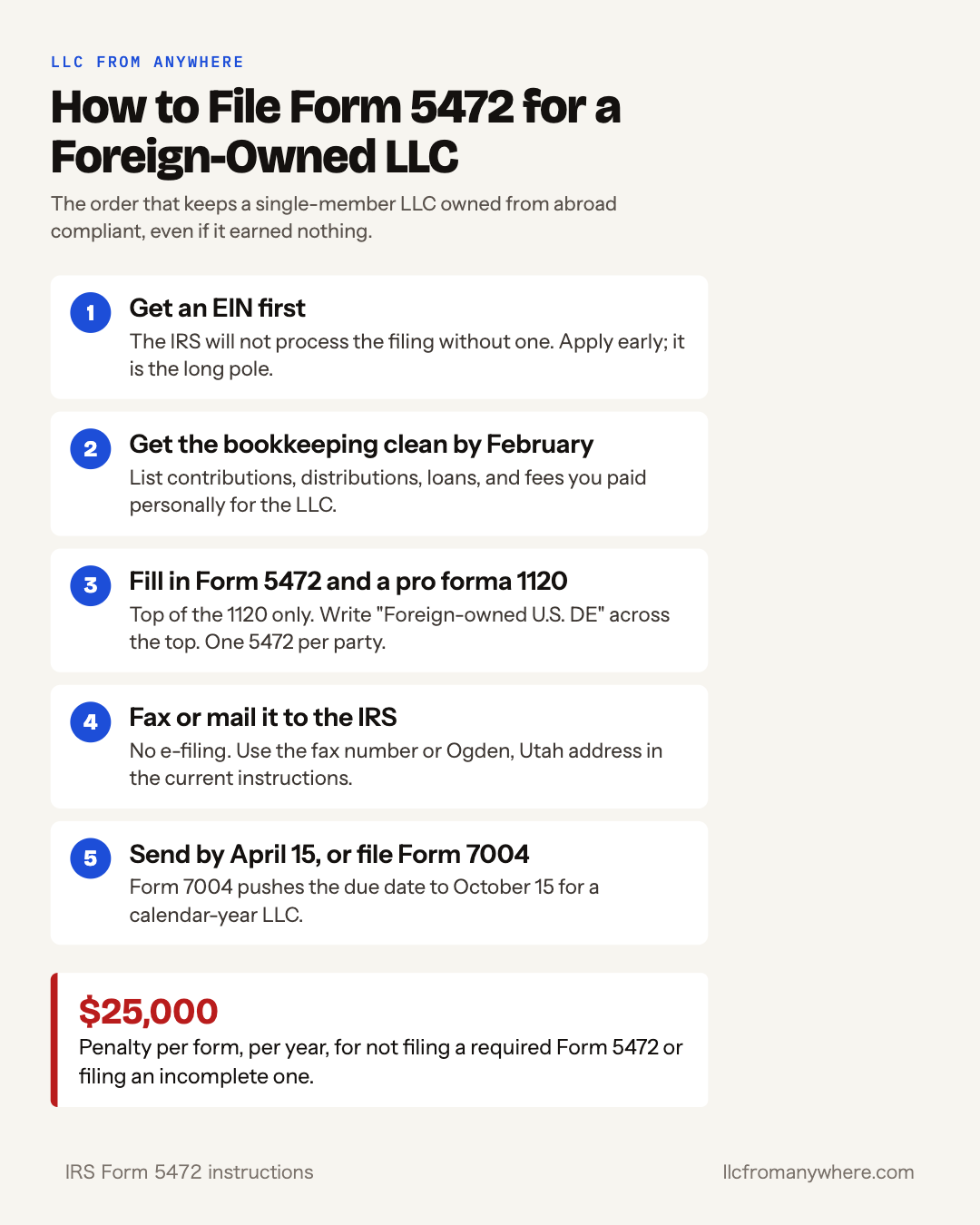
Calendar it: EIN first, bookkeeping clean by February, Form 5472 and pro forma 1120 faxed before April 15, or Form 7004 filed to buy until October 15. That sequence keeps a $25,000 penalty permanently theoretical.
If you would rather hand it off, 1-800Accountant covers the bookkeeping and the filing together, which is the combination that actually keeps a foreign-owned LLC clean year over year.
This is general information, not tax advice — confirm your specific situation with a CPA or attorney who works with foreign-owned US entities.
Tools mentioned in this article
Keep reading
Bizee (Incfile) Review: Is It Legit for Non-US Founders?
An honest Bizee (formerly Incfile) review for non-US residents: what the free formation plan really covers, hidden costs, and when to pick something else.

Northwest Registered Agent Review: Honest Take for Non-Residents
An honest Northwest Registered Agent review: privacy by default, mail scanning, the $125 renewal, the non-resident bundle, and when to skip it.
Single-Member LLC With No US Income: Do You Owe US Tax?
Most foreign-owned single-member LLCs with no US income owe no federal income tax, but Form 5472 and state fees still apply. Here is what to file.
How to Dissolve a US LLC as a Non-Resident (and What It Costs)
Dissolve a US LLC as a non-resident the right way: the state filing, final IRS Form 5472, closing your EIN and bank account, and what each step costs.