How to Fax Form SS-4 From Abroad to Get an EIN
A step-by-step guide to filing Form SS-4 by fax from outside the US, getting an EIN without an SSN, and avoiding the delays that stall most applications.
If you are a non-US resident without an SSN or ITIN, faxing Form SS-4 to the IRS is the fastest way to get an EIN on your own. You cannot use the IRS online EIN application, because it requires a valid SSN, ITIN, or EIN for the responsible party. Fax typically returns an EIN in a few weeks; mail takes longer. There is no SSN requirement anywhere on Form SS-4 itself.
Bottom line
- Fax Form SS-4 to the IRS international fax number for applicants with no legal residence or principal office in the US.
- Write “Foreign” on line 7b where the form asks for the responsible party’s SSN/ITIN/EIN.
- Expect several weeks, not minutes. Build that into your bank account and payment processor timeline.
Why you cannot use the online EIN application
The IRS online EIN assistant rejects applications where the responsible party has no SSN or ITIN. It validates that number in real time, so there is no workaround — the session simply fails. That tool is also restricted to applicants whose principal business is located in the US or US territories.
That leaves three routes: fax, mail, or having a third party apply on your behalf. Fax is the one most non-residents use, because it is the only self-service method with a reasonable turnaround.
Form SS-4 is the IRS application for an Employer Identification Number. An EIN is a nine-digit federal tax ID for a business entity, formatted XX-XXXXXXX. You need one to open a US business bank account, onboard with Stripe or PayPal, file Form 5472, and issue 1099s.
What you need before you fax
Have your LLC formed first. The IRS will assign an EIN to an entity that does not legally exist yet, but it creates a mismatch you will spend months unwinding — the name on the EIN letter has to match the name on your Articles of Organization exactly.
Gather these:
- Exact legal entity name as filed with the state, including “LLC” or “L.L.C.” precisely as registered.
- US mailing address for the entity. This can be your registered agent’s address or a commercial mail forwarding address. A home address abroad is also accepted on line 4, but a US address makes the EIN confirmation letter easier to receive.
- Your foreign address for line 5 if different.
- Responsible party name and foreign address. For a single-member LLC, that is you, as an individual — not the LLC.
- Formation date and state.
- A fax line you can send from and receive on, or a reliable online fax service.
Filling out Form SS-4: the lines that matter
Download the current Form SS-4 and its instructions from irs.gov. Do not use a copy you found on a blog — the form and fax numbers change.
Most of the form is mechanical. These are the lines that cause rejections and follow-up letters:
| Line | What to enter | Common mistake |
|---|---|---|
| 1 | Exact legal name of the LLC | Abbreviating or dropping “LLC” |
| 4a-4b | Mailing address (US address is fine) | Using an address that cannot receive mail |
| 7a | Responsible party’s full legal name | Entering the LLC’s name instead of a person |
| 7b | Write “Foreign” | Leaving blank, or inventing a number |
| 8a | Check “Yes” — it is an LLC | Skipping the LLC block entirely |
| 9a | Usually “Other” with a note, or the disregarded-entity box | Checking “Corporation” by default |
| 10 | Reason: “Started new business” or “Banking purpose” | Checking “Hired employees” when you have none |
| 18 | “No” if this entity never had an EIN | Confusing a prior personal EIN |
Line 7b is the single most important field for non-residents. The IRS instructions direct foreign responsible parties with no SSN, ITIN, or EIN to enter “Foreign.” Write it legibly in that box. Leaving it blank invites a rejection; making up a number is a false statement on a federal form.
On line 9a, a foreign-owned single-member LLC is a disregarded entity for US income tax purposes by default. Many applicants check “Other” and write “Foreign-owned U.S. disregarded entity.” If you intend to elect corporate treatment later with Form 8832, that is a separate filing and does not belong on the SS-4.
Line 15 asks for the first date wages were paid. If you have no employees, leave it blank rather than guessing a date — a date there can trigger payroll filing obligations you do not have.
Sign the form. Print your name and title (“Member” or “Managing Member”) and include a phone number the IRS can actually reach, including the country code.
Where to fax Form SS-4 from outside the US
Applicants with no legal residence, principal place of business, or principal office in the US fax Form SS-4 to the IRS international unit — the number is published on the “Where to File Your Taxes for Form SS-4” page on irs.gov. Verify it on that page the day you send. The IRS has changed these numbers more than once, and a fax to a retired number disappears with no error message.
Two practical points:
Include a cover sheet with a return fax number. The IRS international unit frequently faxes the EIN back rather than mailing it. If you give them a usable return fax number, you may get the EIN in days instead of weeks. Write “Please fax EIN to: +[country code][number]” clearly.
Use an online fax service you can actually receive on. Services like Fax.Plus, eFax, or HelloFax work. Make sure inbound fax is enabled on your plan before you send — a send-only plan means the IRS reply vanishes.
Keep the transmission confirmation. It is your only proof of the filing date if you have to follow up.
How long does it take to get an EIN by fax?
Plan on about four weeks for a faxed Form SS-4 from abroad, though the IRS states a shorter window and actual turnaround swings with their backlog. If you supply a return fax number, responses sometimes arrive within one to two weeks.
If nothing arrives after four weeks, call the IRS Business and Specialty Tax Line international number listed on irs.gov. Have your fax confirmation and a copy of the submitted form in front of you. Do not re-fax a duplicate application — two SS-4s for the same entity can produce two EINs, which is a genuine mess to unwind.
Nothing about this process is faster if you pay someone, with one exception: a US-based third party with an SSN can be designated on the third-party designee block (lines at the bottom of the form) and call the IRS to obtain the EIN by phone on your behalf. That is what most formation services actually do.
Should you just use a formation service instead?
Use a formation service if you want the EIN handled alongformation and you would rather not manage fax logistics. Do it yourself if you have already formed the LLC and want to avoid an extra fee.
The honest math: faxing the SS-4 yourself costs the price of an online fax plan and an hour of care. A service charges a fee and takes the fax, the follow-up calls, and the re-filings off your plate.
Northwest Registered Agent is the one we point non-residents to most often, for a specific reason: they will not sell your data, they give you a real US business address you can put on line 4a, and they will serve as the US point of contact that keeps your EIN letter and state mail from getting lost. If you have not formed yet, doing formation, registered agent, and the US address in one place removes most of the address mismatches that stall EIN applications.
If you want the broader comparison first, see our guide to getting an EIN without an SSN and the walkthrough of Northwest’s LLC setup process.
What to do once the EIN arrives
The IRS sends an EIN confirmation notice (CP 575). Save the PDF and the original. Banks and payment processors will ask for it, and the IRS does not reissue CP 575 — they will only send a 147C verification letter instead.
Your next steps in order:
- Open a US business bank account. Most online-first options want the EIN, formation documents, and passport. See US business bank accounts for non-residents.
- Onboard your payment processor. Stripe and PayPal both verify the EIN against IRS records, so the entity name must match exactly.
- Calendar your federal filings. A foreign-owned single-member LLC files Form 5472 with a pro forma Form 1120 every year, even with zero revenue. The penalty for not filing starts at $25,000. See the annual compliance checklist.
Who should fax, and who should not
Fax Form SS-4 yourself if: your LLC is already formed, you have a US mailing address lined up, you can send and receive fax, and you are comfortable reading the IRS instructions once.
Use a third party if: you need the EIN quickly for a time-sensitive bank or processor application, you are forming the LLC at the same time, or a previous application was rejected and you do not know why.
Do not mail Form SS-4 unless fax is genuinely unavailable to you. Mail from abroad to an IRS service center adds weeks of transit on both ends with no tracking.
FAQ
Can I get an EIN without an SSN or ITIN?
Yes. Form SS-4 has no SSN requirement for the applicant entity, and foreign responsible parties with no SSN, ITIN, or EIN write “Foreign” on line 7b. The restriction applies only to the IRS online application, which validates a US tax ID in real time.
Do I need an ITIN before applying for an EIN?
No. An EIN and an ITIN are separate numbers for separate purposes, and the EIN does not depend on having an ITIN. Most non-resident LLC owners who never have US-source personal income never need an ITIN at all — see ITIN vs EIN for non-residents.
What if the IRS rejects my faxed SS-4?
The IRS will typically mail or fax a letter naming the defect, most often an incomplete line 7a/7b or an entity name that does not match state records. Fix only the identified field and resubmit the corrected form — do not file a fresh application as if the first never happened.
Can my registered agent receive the EIN letter for me?
Yes, if you list their address on line 4a and they offer mail forwarding or scanning. This is a common setup, because an EIN notice mailed to an address abroad can take months or never arrive. Confirm with your agent that IRS mail is included in their service.
Getting it done
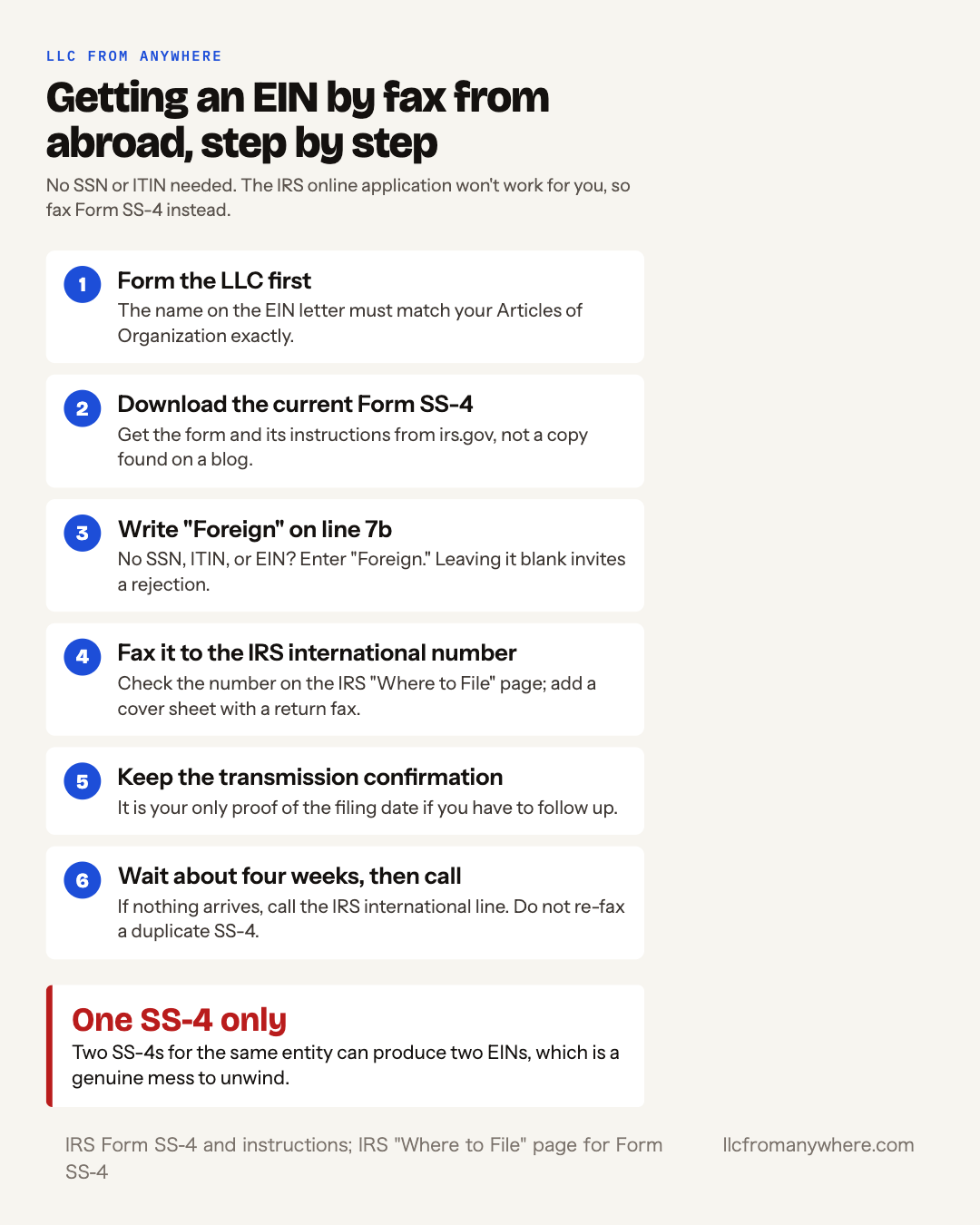
Form the LLC, download the current Form SS-4 from irs.gov, write “Foreign” on line 7b, fax it to the international number listed on the IRS “Where to File” page with a cover sheet giving your return fax number, and keep the transmission receipt. That sequence works, and it costs almost nothing.
If you would rather not manage the fax, the follow-up calls, and a US address separately, set it up through Northwest Registered Agent — formation, registered agent, and a usable US business address in one place, which removes the address and name mismatches that cause most EIN delays.
This is general information, not tax or legal advice. Confirm your specific filings with a CPA or attorney who handles non-resident US entities.
Tools mentioned in this article
Northwest Registered Agent
Registered agent and formation with strong privacy
llc formationTry Northwest Registered AgentKeep reading
Bizee (Incfile) Review: Is It Legit for Non-US Founders?
An honest Bizee (formerly Incfile) review for non-US residents: what the free formation plan really covers, hidden costs, and when to pick something else.
Northwest Registered Agent Review: Honest Take for Non-Residents
An honest Northwest Registered Agent review: privacy by default, mail scanning, the $125 renewal, the non-resident bundle, and when to skip it.
Single-Member LLC With No US Income: Do You Owe US Tax?
Most foreign-owned single-member LLCs with no US income owe no federal income tax, but Form 5472 and state fees still apply. Here is what to file.
How to Dissolve a US LLC as a Non-Resident (and What It Costs)
Dissolve a US LLC as a non-resident the right way: the state filing, final IRS Form 5472, closing your EIN and bank account, and what each step costs.