US LLC Annual Costs for Non-Residents: The Real Yearly Bill
What a US LLC costs per year for a non-resident: state fees, registered agent, Form 5472 filing, banking, and address, with low and typical totals.
For a non-resident, the yearly cost of a US LLC usually falls somewhere between about $150 and $2,100. The state you pick sets the minimum. The total depends mostly on whether you pay a professional to prepare your annual Form 5472 filing. The filing fee is a one-time cost. The fixed costs that keep the LLC in good standing come back every year, and those are the numbers to plan around.
Bottom line:
- Bare minimum: about $150–$400 a year in a low-cost state (Wyoming or New Mexico) if you file the IRS paperwork yourself.
- Typical with professional help: about $700–$2,100 a year once you add a CPA for Form 5472 and the pro forma 1120.
- Most expensive mistake: skipping Form 5472. The IRS penalty starts at $25,000 per missed form.
US LLC annual costs at a glance
US LLC annual costs for a non-resident fall into three groups: state fees, a registered agent, and federal tax compliance. Banking, an address, and software are optional extras. Here’s how the fixed costs compare in the three states non-residents most often choose.
| Cost line | Wyoming | New Mexico | Delaware |
|---|---|---|---|
| State annual fee | $60 minimum annual report license tax (Wyoming Secretary of State) | $0, since LLCs file no annual report (New Mexico Secretary of State) | $400 annual LLC tax, due June 1 (Delaware Division of Corporations) |
| Registered agent | Required, commonly $100–$300/year | Required, commonly $100–$300/year | Required, commonly $100–$300/year |
| Form 5472 + pro forma 1120 | Required for foreign-owned single-member LLCs | Same | Same |
| IRS filing fee | $0 | $0 | $0 |
| Realistic yearly floor | ~$160–$360 | ~$100–$300 | ~$500–$700 |
| Weakest point | Small fee every year | Weaker privacy reputation for annual records, fewer formation-service defaults | Highest fixed cost of the three |
State fees change from time to time, so check the state’s official fee schedule before you file. For a deeper state comparison, see Wyoming vs New Mexico LLC and the best state to form an LLC for non-residents.
What does the state charge every year?
Most states charge an annual or biennial fee to keep an LLC active. Wyoming’s minimum is $60, New Mexico charges nothing for LLCs, and Delaware charges a flat $400. These are the only costs the state itself requires.
Wyoming calls its fee an annual report license tax. It is $60 or a tiny fraction of your Wyoming-based assets, whichever is greater. Nearly every online business owned by a non-resident pays the $60 minimum. The report is due on the first day of the month your LLC was formed.
New Mexico doesn’t require an annual report from LLCs at all, which makes it the cheapest state to maintain. Delaware’s $400 annual LLC tax applies whether or not you made any money. The late penalty is $200 plus interest.
Watch for high-fee states you might not expect. California charges an $800 minimum annual franchise tax (California Franchise Tax Board), and some states require newspaper publication or charge large biennial fees. If you have no real presence in a state like that, there’s usually no reason to form there.
What does a registered agent cost per year?
A registered agent is a person or company with a physical address in your formation state that accepts legal papers for your LLC during business hours. Every state requires one. Non-residents can’t act as their own agent, so this is a cost you can’t avoid.
Commercial registered agents usually charge somewhere between $100 and $300 a year. Some formation services give you the first year free and then renew automatically at full price. Read the renewal price, not the headline price.
We think the agent matters more than the price difference suggests. When your agent misses forwarding a lawsuit or a state notice, your LLC can lose its good standing without you knowing. That’s why we lean toward agents with a long record and clear privacy policies.
Northwest Registered Agent is our pick for most non-residents. It’s known for strong privacy, such as using its own address on public filings where the state allows it, and its renewal pricing is straightforward. See Northwest Registered Agent’s current pricing. For background on the role itself, read what a registered agent is.
The federal filing that drives most of the cost
A foreign-owned single-member LLC must file Form 5472 attached to a pro forma Form 1120 with the IRS every year. It applies even when the LLC owes no US tax. This filing is the biggest swing factor in your yearly budget.
The IRS charges nothing to file. The cost is the time it takes or the fee you pay someone to prepare it. Form 5472 reports “reportable transactions” between the LLC and its foreign owner, which includes money you put in and money you take out.
Here’s the realistic range:
- Do it yourself: $0, but you need to understand the forms. Note that Form 5472 can’t be e-filed by the owner in the usual way, and many people fax or mail it.
- Online compliance service: often a few hundred dollars a year.
- CPA familiar with foreign-owned LLCs: commonly $500–$1,500+, depending on how complex your activity is.
The penalty is what makes this cost non-negotiable. The IRS assesses $25,000 for each Form 5472 that’s missing or substantially incomplete, plus more if it goes unresolved after notice. Our full walkthrough is in Form 5472 for foreign-owned LLCs.
Multi-member LLCs owned by non-residents are a different case. They’re generally taxed as partnerships and file Form 1065 with withholding rules attached, which usually costs more to prepare. Your own country’s tax return is a separate cost as well.
Costs people forget to budget
Beyond the state, the agent, and the IRS, a few smaller costs show up every year. None of them are legally required, but most working LLCs pay for at least two of them.
Business address and mail. Your registered agent’s address usually can’t be used as your business mailing address. A virtual mailbox or mail-forwarding service commonly runs $10–$40 a month. See how to get a US address for your LLC.
Bank and payment accounts. Many online business accounts for non-residents charge no monthly fee. Others charge a monthly fee or fees for wires and currency conversion, which add up if you pay yourself abroad often. Compare options in US business bank accounts for non-residents.
Domain, email, and website. A domain is often around $10–$20 a year, and business email is often a few dollars per user per month. Hosting depends on what you build.
Bookkeeping. A spreadsheet is free. Accounting software usually starts around $15–$30 a month. Clean books make Form 5472 faster and cheaper to prepare, because your preparer needs your totals for contributions and distributions.
EIN. An EIN is free from the IRS. Non-residents without an SSN can apply by faxing or mailing Form SS-4, or through a formation service that charges for the convenience. It’s a one-time cost, not a yearly one. See how to get an EIN without an SSN.
Sample yearly budgets
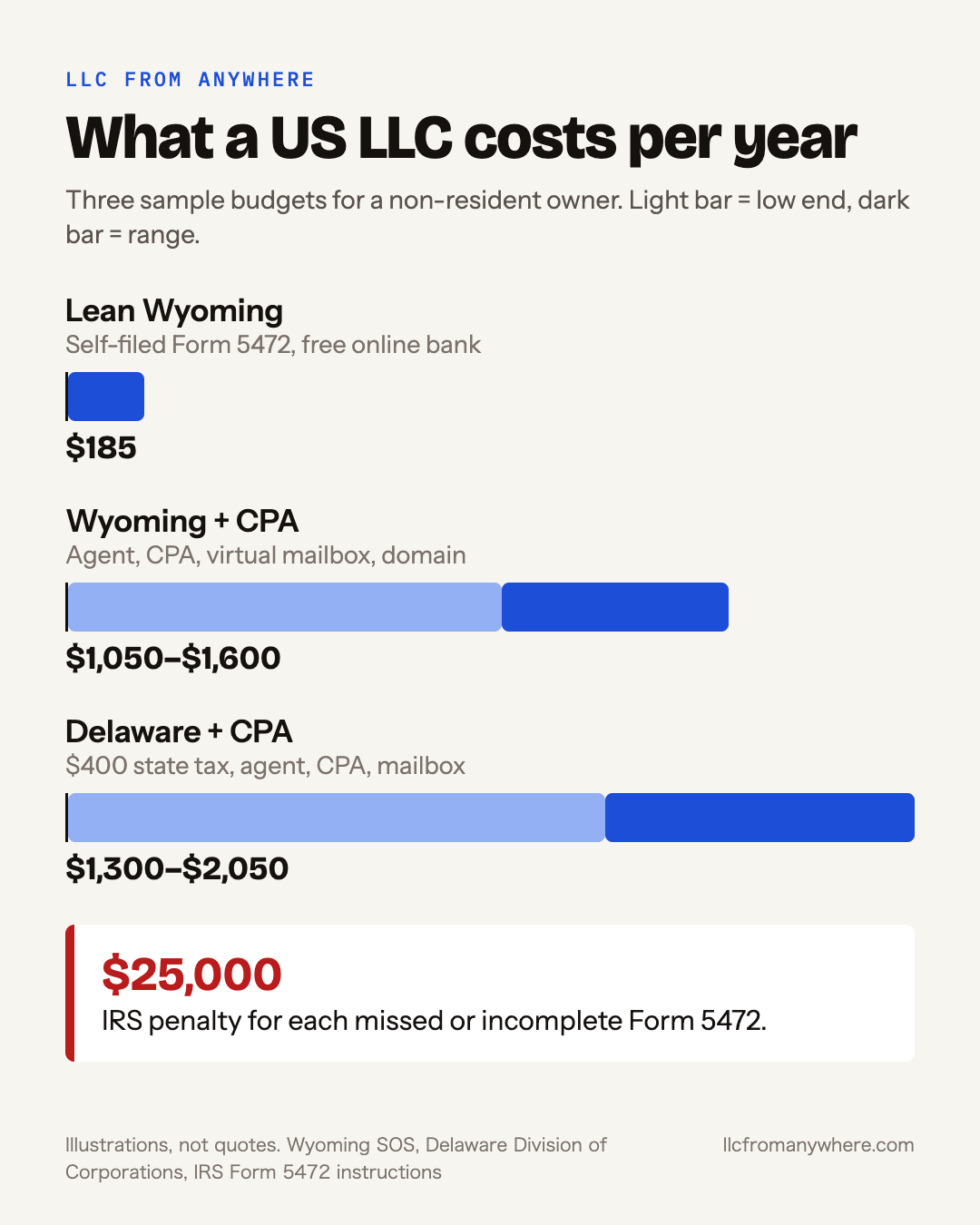
These budgets are illustrations based on the ranges above, not quotes. Your numbers will depend on the providers you choose and how active the LLC is.
Lean Wyoming LLC, owner files their own forms:
- Wyoming annual report: $60
- Registered agent: ~$125
- Form 5472 + pro forma 1120: $0 (self-prepared)
- Free online bank account: $0
- Total: roughly $185 a year
Typical Wyoming LLC with professional tax help:
- Wyoming annual report: $60
- Registered agent: ~$125
- CPA for Form 5472 filing: ~$600–$1,000
- Virtual mailbox: ~$180–$360
- Domain and email: ~$80
- Total: roughly $1,050–$1,600 a year
Delaware LLC with professional tax help:
- Delaware annual tax: $400
- Registered agent: ~$125–$300
- CPA for Form 5472 filing: ~$600–$1,000
- Virtual mailbox: ~$180–$360
- Total: roughly $1,300–$2,050 a year
Delaware rarely pays off for a single-owner online business. If you’re weighing the two, read Delaware vs Wyoming LLC for non-residents.
How to keep the yearly cost low without cutting corners
The best savings come from choosing the right state at the start and not paying for features you won’t use. Cutting the registered agent or skipping Form 5472 to save money will cost you more later.
- Pick a low-fee state unless you have a concrete reason not to, like investors who require Delaware.
- Compare renewal prices for your registered agent, not the first-year promo.
- Turn off add-ons you don’t need. Formation packages often include “compliance” subscriptions that only remind you of deadlines you can track yourself.
- Keep your books monthly, so your tax preparer bills you for filing, not for sorting a year of bank statements.
- Calendar your deadlines. Late fees on a $60 report can quickly cost more than the report. Our annual compliance checklist lists them.
A registered agent that handles state reminders and forwards mail reliably takes care of most of this for you. Compare Northwest Registered Agent’s plans if you want one provider for the agent, reminders, and privacy.
Who should budget for the lean setup
The lean setup fits owners whose LLC has simple activity: one owner, a few clients or one payment platform, and money moving in and out on a predictable schedule. If you’re comfortable reading IRS instructions and you keep clean records, you can realistically stay under $400 a year in Wyoming or New Mexico.
Who should budget for professional help
Budget $1,000 or more if your LLC has multiple members, inventory, US employees or contractors, sales into several states, or substantial transfers between you and the business. Also budget for help if your home country taxes the LLC’s income in a way you don’t fully understand. A preparer who works with cross-border owners pays for themselves the first time they catch a reporting gap.
This is general information, not tax or legal advice. Confirm your filing obligations and costs with a CPA or attorney who works with foreign-owned US LLCs.
FAQ
What is the cheapest state to maintain a US LLC as a non-resident?
New Mexico is usually the cheapest, because LLCs there file no annual report and pay no annual state fee. You still need a registered agent. Wyoming is close behind at a $60 minimum annual report fee.
Do I pay US tax every year if my LLC makes no money?
A foreign-owned single-member LLC with no US-source income often owes no US income tax. It still must file Form 5472 with a pro forma 1120 every year it has reportable transactions, and state fees like Delaware’s $400 annual tax apply whether or not there’s revenue.
Can I skip the registered agent to save money?
No. Every state requires an LLC to have a registered agent with a physical address in that state. Without one, the state can revoke your LLC’s good standing, which can freeze banking and payment accounts.
Is the formation fee part of the yearly cost?
No. The state filing fee to create the LLC is paid once, for example $100 to file in Wyoming through the Secretary of State. For the full first-year picture, including formation, see how much a US LLC costs for non-residents.
Plan the yearly cost before you form
Your yearly bill is mostly set by two early choices: the state you form in and how you handle Form 5472. Choose a low-fee state, choose a registered agent with fair renewal pricing, and decide upfront whether you’ll file the federal forms yourself or pay a professional. Get those right and a US LLC stays affordable for years.
If you’re ready to set up or switch your registered agent, start with Northwest Registered Agent. Their setup walkthrough shows each step before you commit.
Tools mentioned in this article
Northwest Registered Agent
Registered agent and formation with strong privacy
llc formationTry Northwest Registered AgentKeep reading
Bizee (Incfile) Review: Is It Legit for Non-US Founders?
An honest Bizee (formerly Incfile) review for non-US residents: what the free formation plan really covers, hidden costs, and when to pick something else.
Northwest Registered Agent Review: Honest Take for Non-Residents
An honest Northwest Registered Agent review: privacy by default, mail scanning, the $125 renewal, the non-resident bundle, and when to skip it.
Single-Member LLC With No US Income: Do You Owe US Tax?
Most foreign-owned single-member LLCs with no US income owe no federal income tax, but Form 5472 and state fees still apply. Here is what to file.
How to Dissolve a US LLC as a Non-Resident (and What It Costs)
Dissolve a US LLC as a non-resident the right way: the state filing, final IRS Form 5472, closing your EIN and bank account, and what each step costs.